
Monday, December 25, 2006
Merry Christmas!

Thanks for reading Linux Rock Star this year. We've been fortunate to have some great members of the community to interview. This coming year, we hope to have a lot more cool stuff as the Linux Audio community grows. Remember that it's a community effort and to find some way to contribute, whether it's joining in discussions and helping someone out, submitting a bug, donating to an open source project or submitting code. Programs don't get to be awesome by themselves.
Thanks to all the great developers out there and people at irc channels, forums and mailing lists who've helped me out with Linux stuff. I've really enjoyed using these programs this year: Ardour, Musix, 64 Studio, JackLab, Aeolus, Hydrogen, JACK, Zynaddsubfx, AMS and many more. I really look forward to seeing what the new year will bring.
Also, please let me know if you have any good ideas for stories or topics you would like to see covered at Linux Rock Star.
Finally, any orders for the Rock Star Linux pack placed between Dec 27 - Jan 1st will ship out after the 1st.
Merry Christmas, and God Bless.
Borrowed the penguin image from here.
Thursday, December 21, 2006
Sound & MIDI Page Updated
The Sound & MIDI Software for Linux page has been updated with lots of new links to applications, updates and news! Check under, "new additions". Lots of fun stuff to look at!
Monday, December 18, 2006
Interview: SuSE Jacklab Creator Michael Bohle (Part 2)
Q: What is the main purpose of the SuSE Jacklab team?
The main competence of jacklab is communication, support and testings. Jacklab (in its current state) is a step toward a full blown openSUSE based distro. Some members of the Jacklab team are now able to build up a one CD install, because the openSUSE Wiki published an tutorial "how to make a sopenSUSE based build".
Appleonkel (Oliver Bengs) is learning how to make it. He also make the kernels. Olli is also member of the build service now he meet some openSUSE devs and he hopes that for the LAC 2007 in Berlin to release the one CD install (JAD). A CD is a enough for a full studio with kde-light and a browser and YAST. The CD will be pre-configured with my suggestions from the music production side and some graphics for eyecandy.
Q: Is there a chance of seeing the Enlightenment Window Manager as an option?
Yes, the last versions of e17 are pretty stable, so this is an realistic option. I still use e17 on all my systems, but for most of the people KDE is an option, so there will be a very basic KDE. Anyway, I think Konqueror is also for the e17 desktop a very useful filemanager
Q: Will there be a commercial version of Jacklab?
There will be a commercial version of JAD on DVD. The German publisher Nicolaus Millin, www.millin.de (Ex SuSE press) was talking about this with Olli and me. So he now joining the JackLab team. I'm very happy to have an experienced SUSE professional in the team, who have a view for biz.
Q: What sort of differences will there be?
There will be a openSUSE JAD (for free) one CD install. The commercial version, JAD Studio Edition will the be same system, but with commercial samples and maybe a license of Energy XT2.
Q: Would it have different support options?
Yes, I planning pro support for the studio edition and a printed manual. A lot of work.to do.
However, this will come later. First, we must test and develop JAD (JackLab Audio Distribution). The one CD install will always be free. So everyone can join in for free to the user4user support forum at http://forum.jacklab.net.
Q: Are there any good ways for users to get involved with Jacklab?
The best way is to join our IRC channel, irc.freenode.net #jacklab. Here, we are talk and share about development, testing and audio apps. In most cases here is someone who can help.
Q: Sometimes it's a lot nice to get real time help with a problem, or to give feedback.
Yes, thats what we need, feedback. Without feedback, we have no motivation and there are will be no improvements.
Q: So, GPL v2 or v3?
Hehe, I'm not a code developer so thats not on me. As an artist, I prefer to use the Creative Commons Licenses mosty.
Q: Anything else you would like to say about Jacklab?
Yes, ... when I was starting this project, I was a bloody Linux noob, but had good skills as creative computer user.
So I meet with some Linux geeks with a heart for musicans. We learned to communicate and understand each other. Sharing knowledge. So the Linux geeks and music geeks people began to create something new. We learn to play together like in a band.
Q: So Linux people learn more about music, and music people learn more about linux together?
Yes, exactly.
Q: There is some real communication happening then. That's good. I imagine both sides need to learn the “jargon”.
At first there where a lot of misunderstandings, and learning to respect each other. Musicians can be stupid users, and geeks are only human. You know what I mean.
Q: Yes, it takes a lot of patience from both sides.
Yes, but I feel very comfortable in the Linux community right now.
Q: Overall, is the community oriented toward the same goals?
Well, only a very few people like to help actively and there is a lot of chaos about "what's the better distribution”. So much, “blah blah blah”. So to work together with a goal is not so easy.
Q: Would you say it's best to just pick a project you like and stick with it instead of bantering?
Yes, for sure. I mean, when you have energy for bantering, you could better use this energy for something constructive. There are so many ways for active participation. When I was starting Jacklab, I was really sure lots of people would share a vision of a user friendly SUSE based music distribution, but with the time, I have to accept, that most of the people are waiting for someone to serve them something: passive users.
I've realized that I can change something if I do it and share my ideas and desire for a free music production environment base on Linux. So a very few like Appleonkel have realized their role in the game and taken the chance to grow up to something like an openSUSE rt kernel guru.
It's easy for users to fall into that trap of not giving anything back and just expect a free lunch.
Q: What other projects are you working on?
I just produce a German rock band in my "Jacklab Studio One". They are maybe a bit punk; hard, but with a lot of emotion. This production will be released under the CCL and it is a 100% open source product. We produce with Ardour as the main software. I have a small but nice studio, and this will be the first music product made with the "SUSE 10 JAD preview " (never released officially).
In Germany, the bands are not so biz oriented like in the USA. So, this band is a part of the JackLab network, a culture of the new independent open media movement. Other projects will follow, in different places, with different music.
Q: Do they have a website?
They're called Bad Man Dead. They are at www.bad-man-dead.de (hosted by Jacklab) and www.badmandead.de. But this website is in preparation, their almost everyday in the studio and actually find no time for making some html-stuff.
Well, thanks Michael, for talking with Linux Rock Star and sharing about openSUSE Jacklab!
Saturday, December 16, 2006
Interview: SuSE Jacklab Creator Michael Bohle (Part 1)
Michael Bohle is the founder and one of the project leads for JackLab. JackLab is a project for research and support of proaudio / media software for openSUSE Linux. He joins us here at Linux Rock Star to answer some questions about the project, and its future in light of the recent Novell / Microsoft developments and what this means for JackLab users.
Q: JackLab is has a selection of some of the best open source audio programs for openSUSE. How did this project get started, and why for openSUSE Linux?
First: We decided to merge our RPM repository with the free packager group packman (http://packman.links2linux.org/ ) and concentrate our focus to user support and the development of a openSUSE based "JackLab Audio Distribution“ but more of this later in this interview.
Since 1999 I've checked SuSE Linux for its multimedia capacities and always was disappointed. Promising multitrack solutions like SLAB never working for me and playing a simple pcm wave file was sometimes pain in the ass with the open sound system (oss).
In 2004 I was testing the Knoppix based aGNUla DeMuDi live CD and I was very impressed. I'm a musican and music producer so I was always looking for a free music producing platform. Linux seemed to be this, but until DeMuDi it was frustrating to use Linux for creative music and media. So DeMuDi was giving me the first impression, how JACK, the low latency audio input output system working.
But I have special proaudio hardware and a dualscreen system. DeMuDi is based on Debian, and its support for hardware is very basic. So I was checking once again SuSE and all my hardware was detected and configured correctly, but I didn't get JACK and the proaudio apps like MusE to work. But for me it was clear -Linux is the future platform for proAudio so I get the idea of „JackLab“ - an laboratory to delve the capacities of JACK.
Later in 2004 Mathias Nargorni, the developer of Alsa modular and Novell Product Manager, made in cooperation with a popular German music magazine a SuSE 9.2 based Audio Live CD. But there was no installer, and the “normal” SUSE 9.2 pro audio wasn't working well.
I recognized that I have to compile a new kernel and some more. So I get in touch with the free SUSE community. The packager oc2pus (Tony Graffy) offered me to make more proaudio rpms available from a wishlist, that I made, and the hacker gimpel was helping me to make a realtime audio kernel for SuSE Linux. 9.2. To share this, I opened the website jacklab.net. In the same time SuSE was getting open for the community development and so we are joining into openSUSE as one of the first free projects.
Q: Will Jacklab continue in light of the recent Novell / Microsoft developments?
Why not?
For sure we will continue – cos where is the problem? openSUSE is sponsored by Novell, but the community make their own decisions. Remember for example the story with of Gnome vs KDE: Novell wanted to put pressure on to get gnome as default WM through. At last the devs from Nuremberg decided to keep KDE. I don't get any nervous by this deal. I think MS try to contact Linux, because its threatened their biz. Now is the point, that Linux will spread more and more. I think the FSF should concentrate their focus on HURD, and Mark Shuttleworth should look by his own gpl-games.
Anyway: JackLab is a free project. We are feel as a part of the openSUSE community, but we have nothing to do with the biz decisions of Novell.
Q: Are there any changes in the agreement that affect Jacklab / openSUSE users?
No. why?
Q: Will Jacklab be updated for openSUSE 10.2?
I just started with some beta testing and I'm positively surprised. 10.2 seemed to be the best of the “openSUSE” builds (since 10.0) With the actual RT kernel from Appleonkel the rtprios for PAM jack is running flawless.
The last days an tutorial was released, which explains clearly how to build up a own openSUSE distribution, so there is a big chance that Olli and Nico are solve the dependencies to make a stripped down one CD install “JAD” image, based on 10.2. A first release is planned for latest the LAC2007 end of march. But I'm sure a preview will be available in February.
At next I will release a basic tutorial for updating a standard openSUSE into a DAW, there is already a new repository rt for kernels available and I promise: Now it will be very easy to pimp the office girl Suse into a rock queen named Susi ;)
I also tested Ardour 2 on 10.2 with a 2.6.19 rt kernel, with success, so sad that we can't share the ardour2 vst build :( because the GPL don't allow to distribute binarys compiled with the proprietary code headers from the Steinberg SDK.
Q: What are your favorite applications on Audiolinux?
First of all: Ardour. I just produce with the band called “Band Man Dead” a demo cd, and a good workflow is given. A really pro app. I also like SooperLooper for free improvisation with my voice, and the synthesizers ZynAdd and AMS. Together with Hydrogen and Seq24 in sync.
I just testing energyXT2 for Linux... seemed to be that this will be one of my fav in the future. But a lot of beta testing to do.
Q: What sets openSUSE / Jacklab apart from other Linux music distributions?
Not so much. In fact there no big difference between the Linux distributions. But: openSUSE is one of the progressed and user friendliest distributions in the Linux market. YAST is the best developed graphical Linux configuration interface. openSUSE is ready for the enduser, which means, those who working productive with an operating system. But it is open for improvements and a good source for modern, innovative development. Maybe Ubuntu have the better community, but openSUSE is leading in the technological aspect.
So openSUSE is a good base for developing a very userfriendly operating system for studios and musicans. The JackLab Audio Distribution (powered by openSUSE) will be fast, slim but complete, beautiful and fully compatible to the main openSUSE distribution.
But in the core, the audio apps and other items like RT kernel similar to all other Linux distributions -it has something to do with taste, but the ingredients are always the same source code. It is simply Linux.
Q: Why do you value Open Source software?
I choose it, because I can work freely with it. I feel safer with a opensource DAW software; cos I'm not depend on the update cycles of the manufacturers of proprietary software. I've got the freedom, to to share the app, for example Ardour, with the customer of my mobile studio, so they can edit their audio
tracks by themselves without spending lots of money or breaking software copyright laws. I like the open project file format of Ardour, because in fact “shit happens” and so I have the option to edit and repair the project file in clear text , XML based.
In addition I think, that a free culture needs independent and free production tools.
Q: How is the weather in Germany today?
Fuckin' foggy cold, it is autumn it its last state. I'm happy to be here in my warm studio ;)
Wednesday, December 13, 2006
Rock Star Linux Pack!
 Support Linux Rock Star by purchasing the Rock Star Linux pack: The newest versions of 3 of the best Linux Music Distributions on CD plus an exclusive Linux Rock Star logo keychain! Save time on downloads and start making some music!
For $10 + $3 S&H you get
Graphic Labeled CDs + Cases + logo Keychain:
* 64 Studio (32 or 64 bit) (installable)
* Musix (live, installable)
* dyne:bolic (live, installable)
* Exclusive Linux Rock Star Logo Keychain
With the live CDs, you can try out Linux now, and install when you're ready. By purchasing the Rock Star Linux pack, you'll be supporting more great interviews, articles, and tutorials on Linux Rock Star!
Buy now with PayPal and get ready to rock!
Friday, December 01, 2006
64 Studio 1.0

The Linux distribution 64 Studio has reached version 1.0! This is a distribution with a large selection of music apps that is available in 64 bit and 32 bit versions.
From the press release:
"The 64 Studio project produces a distribution of native free software for digital content creation on x86_64 hardware (AMD's 64-bit CPUs and Intel's EM64T chips). After eighteen months of development, the project has made its first stable release available for free download. It is named in recognition of the work of Glyn Johns and Eddie Kramer at Olympic Studios in London."
64 Studio Homepage
Download
Sunday, November 26, 2006
UPDATE: Dynebolic 2.3

A new version of Dynebolic has been released, here are some changes, from the release notice:
Starting from this release dyne:II core runs efficiently on solid state devices, loading its system from a compact-flash or similar controller. It has been tested on some embedded setups with extremely good results in terms of speed and power saving. Moreover, this release significantly improves stability and performance, running on a brand new 2.6.18 kernel optimized for low latency realtime. New and updated software include: VNC for remote desktop operation and recording, MPlayer and ffmpeg audio/video codecs, DVD recording tools, Ksubtitle editor, FUSE and pcmcia card autodetection.
Saturday, November 18, 2006
Commodore 64 and Linux
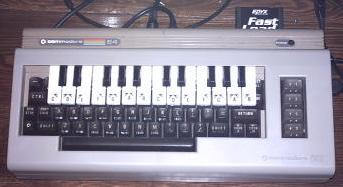
Back in 1982, a personal computer was released that would one day be a cultural phenomenon. The Commodore 64, if you’re not familiar with it, was an amazing computer for its day. It had games and applications galore and was easy to program.
The Sound Interface Device (SID) of the Commodore 64 has lived on as a cult classic. It sounds like a 70’s analog synthesizer or something out of a video game nightmare. It’s difficult to define, yet easy to understand when you hear it. It lives on in the form of hardware synthesizers like the Elektron SidStation, the HardSID internal sound card, midibox SID DIY project, the modern Prophet64 cartridge, software based synthesizers like the quadraSID and Goattracker.
VICE is a Commodore 64 emulator that is available for Linux. This program gives access to a number of Commodore 64 music programs. Here are some programs to download and try out with VICE:
• CyberTracker – Old School style tracker
• Prophet64 1.0 – Emulates a TB303, TR909, and an analog Synth; free version download
• SAM – (Software Automatic Mouth) Old School Robot Speech Synth
• White Box – One of many music collection disks
• Cynthcart – Live performance synth
• Retroskoi – Another live programmable synth
There’s also a huge number of C64 tunes you can listen to natively in Linux at the High Voltage SID collection, an archive of thousands of C64 tunes. They are pretty small and can be listened to in SIDPLAY or the SIDPLAY XMMS plugin.
• High Voltage SID Collection – Archive of SID song files
• SIDPLAY for Linux, XMMS plugin for SID files
• VICE – Linux C64 emulator
• ReFX QuadraSID – This VST plugin works pretty well with FST
• Unknown 64 – Another VST plugin
• GoatTracker - Comes with source code, compiles on Linux - native tracker app
Wednesday, November 15, 2006
Interview: Energy XT Creator, Jorgen Aase
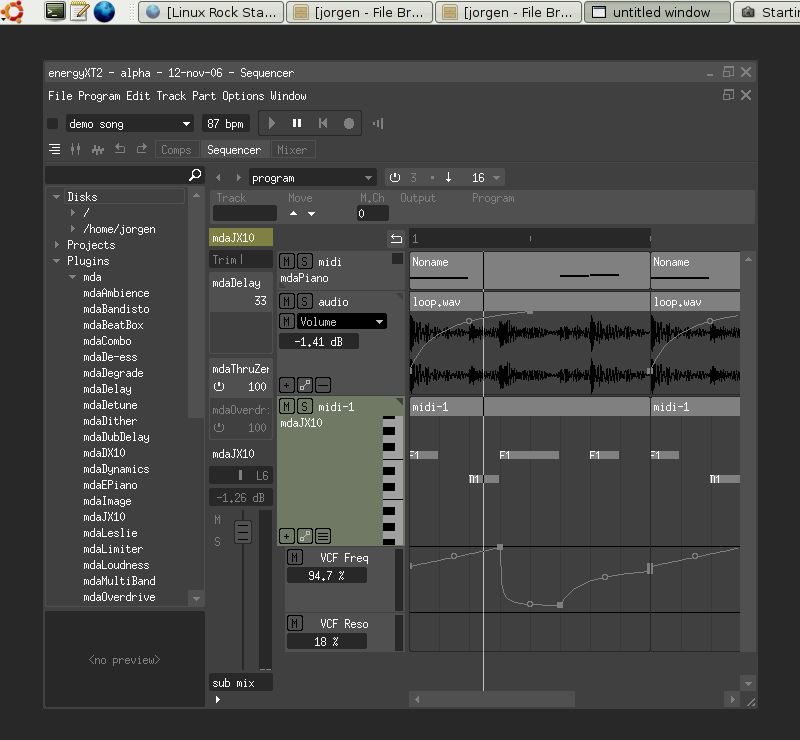 Jorgen is the creator of Energy XT, a modular music creation program available for Windows that is currently in development and scheduled for a Linux release. Energy XT, a program already widely used and praised, will be making a Linux debut, marking one of the first available commercial music applications for Linux.
How would you describe energyXT?
energyXT is an advanced music composer and plugin chainer. It can be run as a standalone application or as a plugin in another DAW to overcome it's limitations. energyXT2 is designed to be very easy to use with drag and drop, streamlined mixer and a very user friendly piano-roll. And when the final version of energyXT2 is out, it will have a built in synth/sampler and multi-effect processor so that you can create music “out of the box”.
Jorgen, why did you decide to port energyXT to Linux?
I guess I always wanted to. Linux is great, it has a lot of free programming tools and it is community driven just like energyXT. I really luve the fact that Linux can be installed on almost anything, and I cant wait to see what new super-gadgets will show up in the near
future powered by Linux. Just think about running your favorite music software on something like the GP2X but with a somewhat bigger screen and wireless headset mic and midi keyboard.
What sets energyXT apart from other music applications?
Well, it has a lot of cool users and the community is just great. In many ways, energyXT2 is a result of years of feedback and suggestions from the user base. What really sets energyXT2 apart from other music software though, is the huge feature set without being bloated. It is
very small in size, snaps open in a split second, but yet has all the features you would need from simple midi editing to advanced time-stretching and pitch-shifting. Oh, and its fully skinnable.
What do you think of Linux as a music/audio production platform?
I actually see Linux as the future of music production platforms, but at the moment I'm very comfortable with cross-platform development. I want energyXT users to be able to choose what works best for them, so supporting both Windows and Linux from version 2.0 and on is just great. Linux may not have a reputation for being a platform for music, but it works great for me and all new improvements and kernel patches that make their way into the mainline kernel is a bonus.
Will VST's work in Linux under energyXT, if so, how?
Well, yes and no. energyXT2 will support VST's but only if they are compiled for Linux. Of course, there are not a lot of those around at the moment but audio guru Paul Kellett from maxim digital audio (www.mda-vst.com) let me re-compile for Linux all “mda” VST instrument
and effects he has made. And so I did. You'd better check out that mdaJX10 synthesizer, it really sounds great.
What kind of feedback have you received since you announced a Linux version?
All positive. There are energyXT users that use Windows only for music, and they are just waiting for energyXT2 to be released so that they can wipe that Windows XP partition form their HD. And there are Linux musicians thanking me for including the Linux platform when developing (affordable) music software. Well, public beta testing of energyXT2 starts in December so we'll see how the reactions are then. I can't wait!
Will Windows users and Linux users have access to versions of the program for both OS's, or will they be separate liscenses?
They will have access to both. The license is personal, and it means that users may install energyXT2 on any of their computers. So if you have Windows on your desktop PC and Linux on your laptop, you need only buy one license.
What do you think about open source software?
I think it's great, and I have all respect for people that develop software and share it with others for free. I don't favor one license over the other though, and hope to see both open source and affordable commercial software on Linux in the future. I really don't mind paying for software that developers have spent thousands of hours to complete, and just think about all the hair pulling trying to nail those bugs.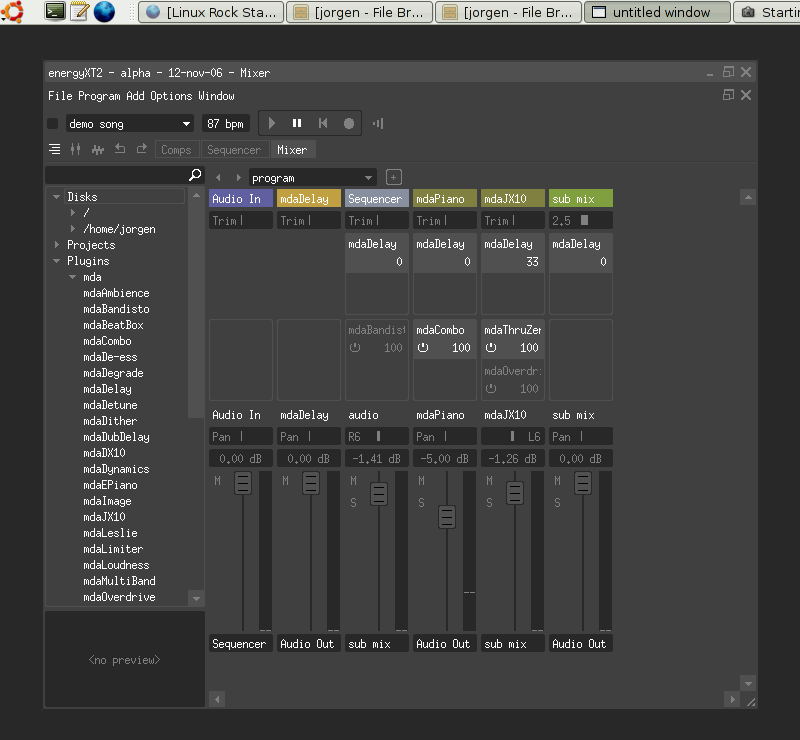 Are there any Linux applications you use or would use in conjunction with Energy XT?
No, its all energyXT2 over here, still it would be great to see more native VST plugins for Linux. But they will come for sure.
What distribution of Linux do you run?
Ubuntu, it's easy to install and easy to upgrade. I do find it a bit bloated though so I'm always on the lookout for something new, but I never download a distro that doesnt fit on a single CD-ROM.
Random concluding question: What is your favorite movie?
I was thinking Bladerunner, but anything with Lara Croft will do;)
Thank you, Jorgen, for hanging out with Linux Rock Star and talking about EnergyXT!
Find out more about EnergyXT:
Friday, November 03, 2006
ArtistX: Debian GNU/Linux Multimedia Art Distribution
 ArtistX is a live DVD distribution of Linux.
From the homepage:
"ArtistX is a LIVE DVD containing nearly all the free multimedia softwares for audio, 2D/3D graphics and video production for the GNU/Linux operating system. No need to install it on the hard disk as it is a bootable DVD, but you can of course install Debian GNU/Linux and addl the most useful softwares for you by yourself. "
This looks very interesting with a lot of great applications. Check it out.
Link: ArtistX.org
Tuesday, October 24, 2006
Mute Renamed to Aldrin

"Mute", the opensource tracker built to be buzz compatible, has been renamed to "Aldrin" and version 0.2 is now available for download.
Link: Aldrin Modular Sequencer
Monday, October 23, 2006
Update: 64 Studio 0.9.5
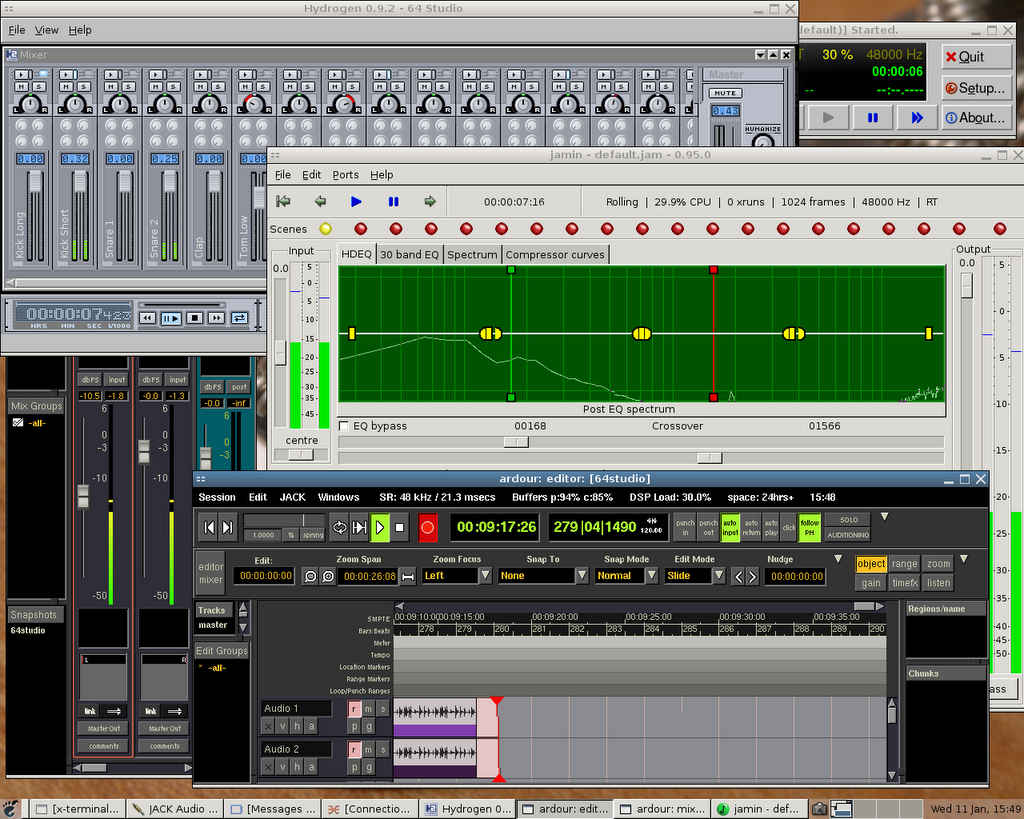 A new version of 64 Studio has been released! It is now up to 0.9.5. This is a Linux music distribution that is made for 64 bit processors (AMD's 64-bit CPUs and Intel's EM64T chips). This is a great option if you have one of these processors and are frustrated with 32-bit Windows apps. Go check it out!
64 Studio Hompage
Screenshot from 64 Studio Homepage
Monday, October 16, 2006
Linux Kernel & Realtime Support
It looks like the mainstream Linux kernel might be headed toward including realtime support, an option that previously needed a patched or replaced kernel from the standard Linux kernel in most distrubutions. This means a lot more systems capable of doing quick realtime audio work.
Story at LinuxDevices.com
Monday, October 02, 2006
New Tracker: Mute (Buzz Compatible)
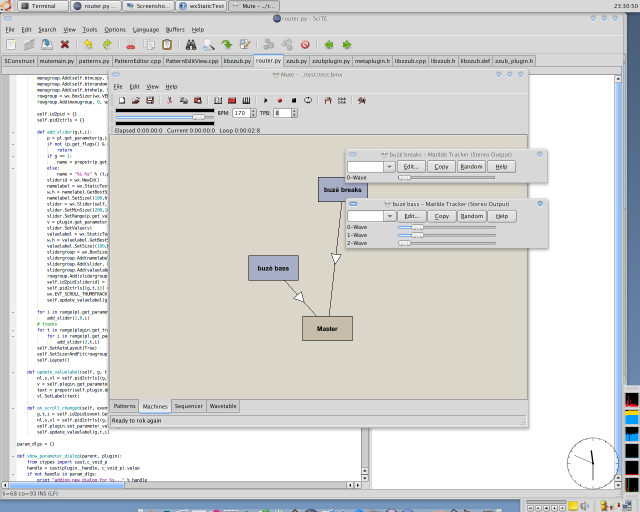
From the Mute homepage:
"Mute is a Linux based Buzz clone, designed to be 1:1 compatible to the discontinued but popular modular music tracker Jeskola Buzz, currently in an alpha development stage. It also occasionally builds and runs on Windows."
This isn't released yet, but you can get it from SVN repositories if you want to see what it's like.
Links
Buzz - The original Tracker for Windows
Mute - The new Linux Tracker
Tracker - Wikipedia entry if you want to know what a "tracker" is
Sunday, October 01, 2006
Frets on Fire

Okay, so this is a little different. FretsOnFire is an awesome party game like Guitar Hero, but different, and it is open source and available for Linux! This should make a nice diversion from intense composing. Also available for Windows for the unenlightened.
Link: Frets On Fire
Note: I couldn't get this to run on SuSE 10.1, I get this error:
downerczx@(none):~/FretsOnFire> ./FretsOnFire
Traceback (most recent call last):
File "/home/skyostil/src/cx_Freeze-3.0.3/initscripts/Console.py", line 27, in ?
File "src/FretsOnFire.py", line 27, in ?
File "src/GameEngine.py", line 34, in ?
File "src/Data.py", line 26, in ?
File "ExtensionLoader_pygame_mixer.py", line 12, in ?
ImportError: libsmpeg-0.4.so.0: cannot open shared object file: No such file or directory
downerczx@(none):~/FretsOnFire>
Wednesday, September 27, 2006
Playing with Bristol

After playing around with Bristol for a little while, I can say that this is some serious fun. I used to have a book of vintage keyboards and wished that I could play with them. Now, here they all are under Linux. The ARP synths are especially fun. JACK support is missing right now, but is being worked on. In the picture above, I was playing 3 synths at once. See posts below for info on downloading Bristol.
Here's a list of equivalent synth emulations from Bristol:
Arp Axxe
Arp Odyssey
Arp 2600
Moog Mini
Moog Voyager (Bristol "Explorer")
Sequential Circuits Prophet-5
Sequential Circuits Prophet-10
Sequential Circuits Prophet-52 (the '5' with chorus)
Roland Juno-6
Yamaha DX-7 (Well, perhaps an FM-7)
Hammond (single manual) module
Hammond B3 (dual manual - see below)
Vox Continental
Fender Rhodes
Fender Rhodes Bass Piano
Oberheim OB-X
Oberheim OB-Xa
Korg MonoPoly
Korg Poly6
Mixer (-libtest only)
Tuesday, September 26, 2006
New Version of Rosegarden 1.4.0
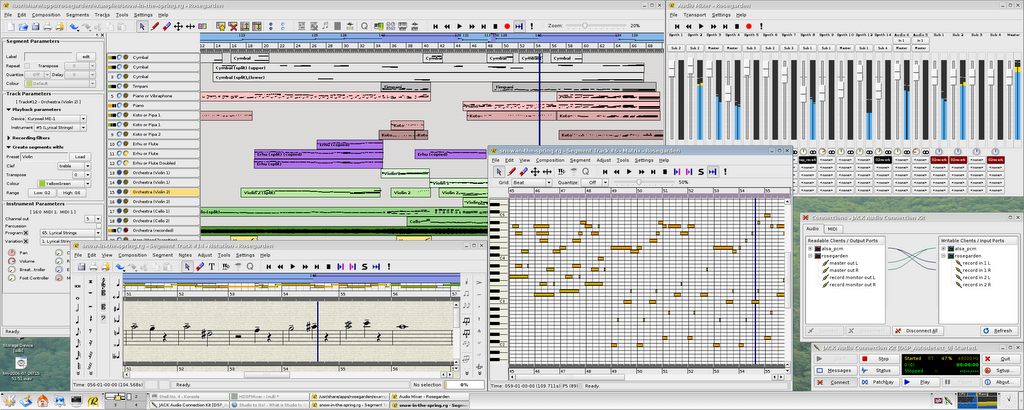
"Rosegarden is a professional audio and MIDI sequencer, score editor, and general-purpose music composition and editing environment." from the Rosegarden Homepage.
This is a well developed Linux project that is making great strides toward excellence in music applications on Linux. Be sure to check this one out.
Picture from Rosegarden Homepage. Download the program there!
Take a tour of Rosegarden.
Virtual Synth: Bristol 0.9.5-60
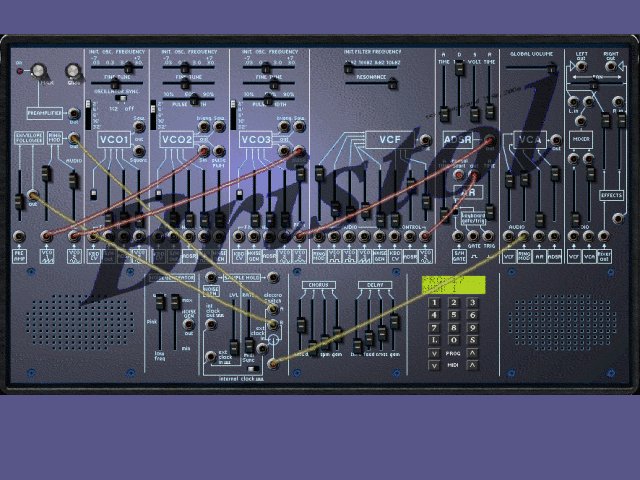 A new version of Bristol, a synth emulation package that models Moogs, Arps, Hammonds, Rhoads, Oberheim and many more synthsizers is now available.
Screenshot from here.
Get Bristol at it's Homepage.
Click the 0.9.3 dropdown and the new 0.9.5-60 will appear under it or download here (direct link).
Thursday, September 14, 2006
New Free Tunes made with Linux
From this post on Linux Audio User comes some tunes:
Created in reverse cronological order over a period of about half a year using mainly: linux, muse, soundfonts, ladspa plugins, more ladspa plugins, some gigs pod's, guitars, microphones, deformed ears and total lack of sense. For the genreholics out there I would put them in the following categories, top to bottom: spam-metal/ambient/blues/mono-metal/jazz/bluesfusion
For more info about the songs and also older material see the site:
http://spamatica.se/musicsite/
Friday, September 08, 2006
Links: More Linux music links than you can imagine
 "Sound and MIDI Software For Linux" is one of the oldest, most respective Linux music sites on the net. Here, categorically arranged, are every type of music and audio application for Linux, from Audio Plugins to Hardware to Mixers to Software Synthesis and more, this is a huge cache of Linux audios apps.
The New Additions page is a good place to start, to see the latest apps. One problem is that many of the entries may link to projects that have been abandoned, or are outdated, so it pays to look for stuff that is updated, however, there are also many good "finished" apps that are perfectly useful, though not updated frequently.
The site appears to be updated about every two months, so it follows that a new update might appear sometime in the next month or so.
Take a look and start exploring the diverse selection of Linux music applications.
Sound and MIDI Software for Linux


